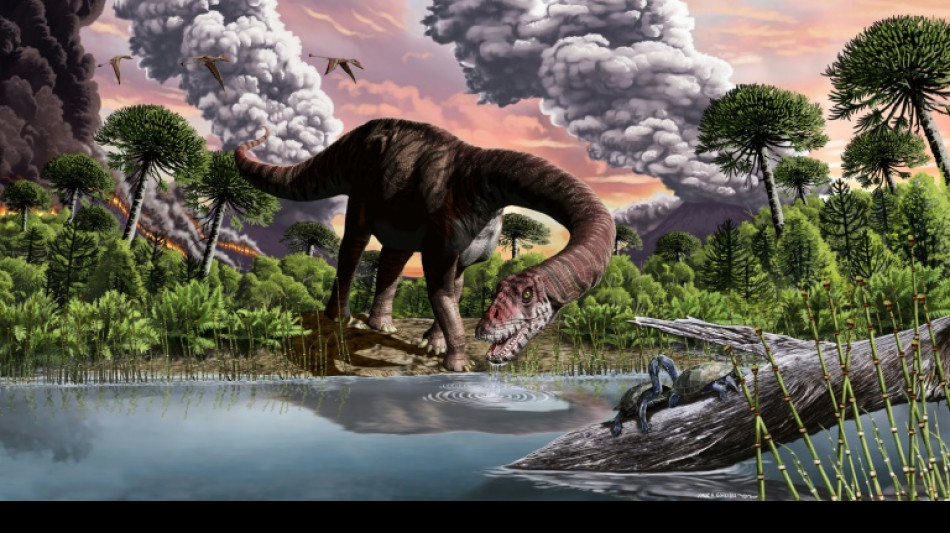
Faeces, vomit offer clues to how dinosaurs rose to rule Earth / Photo: Jorge GONZALEZ - MUSEO PALEONTOLOGICO EGIDIO FERUGLIO/AFP/File

Faeces, vomit and fossilised food from inside stomachs have provided new clues into how dinosaurs rose to dominate Earth, a new study revealed on Wednesday.
Scientists have discovered plenty about dinosaurs -- particularly about how they vanished off the face of the planet 66 millions years ago.
But "we know very little about their rise," Martin Qvarnstrom, a researcher at Sweden's Uppsala University and the study's lead author, told AFP.
Dinosaurs first appeared at least 230 million years ago, fossils have shown.
But they would not become the world's dominant animal until the start of the Jurassic Period some 30 million years later.
What caused this ascension -- and why it took so long -- have long been a subject of fevered debate between scientists.
For the new study in Nature, a European team exhaustively probed more than 500 "bromalites" -- the fossilised remains of dinosaur faeces, vomit and undigested food inside intestines -- from sites in Poland.
"By linking the bromalites to the producers and identifying what's in them, we can start connecting who ate whom or who ate what," Qvarnstrom explained.
The researchers used new technology such as synchrotron microtomography to build a 3D image of the samples.
This revealed that the excrement contained the remains of insects, plants, fish and bigger animals.
The researchers compared this with data about fossils, plants and the climate to construct a model for the step-by-step rise of the dinosaurs.
- 'Opportunistic animal' -
This ascension was illustrated by the bromalites themselves, which tripled in average length and width over the 30 million-year period.
This demonstrated how the animals that digested, vomited or excreted these remains tripled in size over that time.
Some of the fossilised remains belonged to an early ancestor of dinosaurs, the Silesaurus.
Far from the mighty T-Rex, the "pretty small" Silesaurus weighed around 15 kilograms at most, Qvarnstrom said.
The dominant animal at the time were barrel-chested herbivorous reptiles called Dicynodonts, which weighed a few tons.
But Silesaurus had a big advantage over its stocky rival -- it was omnivorous.
"What we see from its droppings is that it was eating a lot of insects, fish and plants," Qvarnstrom said.
This meant the "opportunistic animal" was better at adapting to sudden changes in the environment.
For example, a massively rainy period called the Carnian Pluvial Episode lead to the evolution of many new plants.
The big herbivorous reptiles struggled to adapt to this new diet.
But the Silesaurus -- and later long-necked dinosaurs that were ancestors of the Diplodocus -- "were able to just feast on all these new plants", Qvarnstrom said.
As the smaller dinosaurs grew bigger from this new grub, so did larger carnivores that fed on them.
By the time the Jurassic period rolled around, the landscape was dominated by giant plant-eating dinosaurs and ferocious carnivores.
- Two competing theories -
The study will not settle the debate about what led to the rule of dinosaurs once and for all.
There are two main theories for their rise. One is that early dinosaurs used key physiological advantages -- such as standing upright -- to outcompete their rivals.
The other is that environmental upheaval, such as volcanic eruptions or a changing climate, killed off many of the previously dominant animals, creating an opening at the top.
The researchers behind the bromalites study suggested it was a combination of the two theories, in which the dinosaurs used their evolutionary advantages to capitalise on environmental changes that had knocked back their rivals.
Lawrence Tanner, a researcher at Le Moyne College in New York, said the study "should be seen as a starting point for further work".
Although its methodology is "particularly creative", the study is "limited in its context and scope", Tanner commented in an attached Nature paper.
The research only covers the Polish Basin region, which at the time was part of the north of the Pangea supercontinent, he observed.
Qvarnstrom agreed, saying that he thought it would be "really cool" to use the model the team developed on other regions -- such as the south of Pangea, where the first dinosaurs appeared.
(L.Kaufmann--BBZ)