Berliner Boersenzeitung - Archaeological 'breakthrough' could confirm origins of Paris

EUR -
AED 4.186334
AFN 72.373386
ALL 91.819032
AMD 414.329313
ANG 2.040604
AOA 1046.308965
ARS 1736.438573
AUD 1.622565
AWG 2.052441
AZN 1.935038
BAM 1.954094
BBD 2.293688
BDT 140.13319
BGN 1.918735
BHD 0.429293
BIF 3430.040844
BMD 1.13977
BND 1.454987
BOB 13.956366
BRL 5.933183
BSD 1.138751
BTN 109.052098
BWP 15.506326
BYN 3.440732
BYR 22339.490623
BZD 2.290391
CAD 1.611464
CDF 2632.86865
CHF 0.944412
CLF 0.027869
CLP 1100.584154
CNY 7.649395
CNH 7.664498
COP 3771.430311
CRC 517.768407
CUC 1.13977
CUP 27.33014
CVE 110.173164
CZK 24.374949
DJF 202.790961
DKK 7.475814
DOP 67.723548
DZD 152.4335
EGP 59.007482
ERN 17.096549
ETB 184.742006
FJD 2.561348
FKP 0.862524
GBP 0.86109
GEL 2.980539
GGP 0.862524
GHS 13.226974
GIP 0.862524
GMD 83.771254
GNF 10015.651322
GTQ 8.696751
GYD 238.271386
HKD 8.940413
HNL 30.565522
HRK 7.532852
HTG 149.035769
HUF 365.880943
IDR 20451.347758
ILS 3.474087
IMP 0.862524
INR 109.244041
IQD 1491.856443
IRR 1566699.250831
ISK 137.194093
JEP 0.862524
JMD 180.16271
JOD 0.80806
JPY 179.359321
KES 147.634133
KGS 99.670824
KHR 4631.139653
KMF 493.520612
KPW 1025.793299
KRW 1547.043722
KWD 0.351778
KYD 0.948963
KZT 504.43199
LAK 25543.707706
LBP 101979.593567
LKR 375.995038
LRD 195.876724
LSL 18.579912
LTL 3.365444
LVL 0.689436
LYD 7.280644
MAD 10.928191
MDL 20.213176
MGA 5027.809004
MKD 61.521701
MMK 2392.945475
MNT 4101.841018
MOP 9.200287
MRU 45.812406
MUR 54.173732
MVR 17.610039
MWK 1974.654001
MXN 20.209238
MYR 4.643648
MZN 72.842889
NAD 18.579912
NGN 1511.072482
NIO 41.905069
NOK 10.826384
NPR 174.483557
NZD 2.014139
OMR 0.438243
PAB 1.138751
PEN 3.865977
PGK 5.073771
PHP 71.188322
PKR 315.551978
PLN 4.378101
PYG 6712.404787
QAR 4.15104
RON 5.274175
RSD 117.47723
RUB 95.91289
RWF 1683.015885
SAR 4.273917
SBD 9.118743
SCR 15.721688
SDG 685.570211
SEK 11.304968
SGD 1.456283
SHP 0.860528
SLE 28.095283
SLL 23900.396288
SOS 650.857469
SRD 42.932281
STD 23590.93636
STN 24.479595
SVC 9.964694
SYP 14819.288917
SZL 18.575516
THB 38.08598
TJS 10.505443
TMT 4.000592
TND 3.371157
TOP 2.744292
TRY 55.806899
TTD 7.745544
TWD 36.20588
TZS 3014.689163
UAH 50.994393
UGX 4460.282073
USD 1.13977
UYU 45.620571
UZS 13477.351914
VES 971.575734
VND 29606.663696
VUV 135.070044
WST 3.152014
XAF 655.957
XAG 0.017731
XAU 0.000266374203
XCD 3.080285
XCG 2.052155
XDR 0.805876
XOF 655.957
XPF 119.331742
YER 269.726859
ZAR 18.618062
ZMK 10259.293596
ZMW 22.214483
ZWL 367.005452
SSP 6511.040469
MXV 2.290148
  • RBGPF

    -1.0100

    65.99

    -1.53%

  • RYCEF

    0.0000

    19.67

    0%

  • GSK

    -0.5600

    49.09

    -1.14%

  • VOD

    0.1100

    16.6

    +0.66%

  • NGG

    -0.1900

    75.04

    -0.25%

  • CMSC

    -0.0100

    20.5

    -0.05%

  • AZN

    1.7000

    166.26

    +1.02%

  • BCE

    -0.2000

    21.1

    -0.95%

  • RIO

    0.0200

    94.49

    +0.02%

  • RELX

    0.0550

    33.565

    +0.16%

  • BP

    -0.4600

    43.95

    -1.05%

  • BCC

    1.3250

    77.425

    +1.71%

  • CMSD

    -0.0510

    20.319

    -0.25%

  • JRI

    -0.1400

    11.03

    -1.27%

  • BTI

    -0.6000

    55.42

    -1.08%

Archaeological 'breakthrough' could confirm origins of Paris
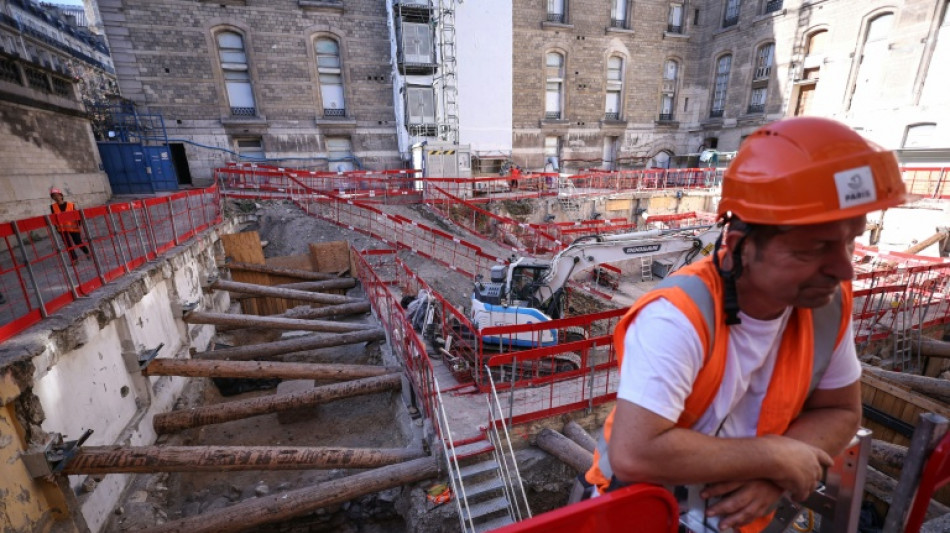
Archaeological 'breakthrough' could confirm origins of Paris / Photo: SIMON WOHLFAHRT - AFP

Archaeological 'breakthrough' could confirm origins of Paris

An ancient wall discovered in central Paris was hailed as a "major breakthrough" on Wednesday, as the archaeological find may have settled a long-standing debate about the location of the city's original settlement.

Text size:

A roughly 20-metre (66-foot) wall dating from the Gallo-Roman period was discovered in Paris this summer beneath a hospital on the Ile de la Cite, a stone's throw from Notre Dame Cathedral, the French culture ministry said.

The stone-and-wood find is thought to be a fragment of the ramparts of Lutetia -- the ancient name for Paris -- built by the Gallic Parisii tribe which lived along the river Seine in the Iron Age.

The Ile de la Cite has traditionally been regarded as the centre of Lutetia, but a rival theory, backed by archaeological research, contends that it was actually in Nanterre, a suburb to the west.

"We may be looking at one of the most important remains ever discovered for understanding Gallic Lutetia," Culture Minister Catherine Pegard said in a statement, which described the discovery as "a major breakthrough".

"Scientific caution still requires that we verify its function and its chronology, but the convergence of evidence is particularly remarkable at this stage."

Lutetia was first mentioned in book seven of Roman leader Julius Caesar's "Gallic Wars" series, where it was said to be on an island in the river Seine linked by bridges -- a vague description that has given rise to many theories about its location.

- 'Dizzying' -

The wall, uncovered in the course of excavations beneath the Hotel-Dieu hospital, also bears traces of fire, which may correspond to Caesar's account that the Gauls set fire to their town before the Battle of Lutetia against the Romans.

Through carbon-dating technology, the charred evidence is estimated to date from 10-200 BC, the ministry said in its statement -- a timeframe that includes the Battle of Lutetia in 52 BC.

The Ile de la Cite, home to Notre Dame Cathedral, is the largest island in the river Seine in the Paris region and became the centre of the Roman settlement of Lutetia.

"It's dizzying to find oneself here and to discover what is probably the origin of the city of Paris," Paris mayor, Emmanuel Gregoire, said on Wednesday after examining the wall.

It is barely a metre high and had been buried four metres deep in a courtyard of the Hotel-Dieu hospital, which is the oldest of the capital.

An archaeological dig began there in February.

"All of our predecessors dreamed of finding traces of Gallic presences on the Ile de la Cite," said Dorothee Chaoui-Derieux, coordinator of archaeological operations in Paris for the culture ministry.

"There has been a lot of speculation on the subject. We're fortunate to be in the right place at the right time," she added.

"Beneath our feet, thanks to the trowels of our colleagues, this wall built in the Gallic tradition is gradually revealing its secrets."

(B.Hartmann--BBZ)