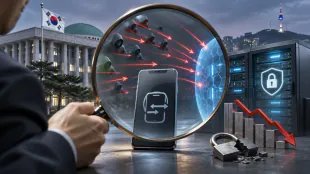
US patent disputes involving Korean chipmakers reach record level

Korean semiconductor companies were involved in a record 20 US patent cases through the third quarter, as disputes over high-bandwidth memory and chip packaging increased.
Samsung Electronics and SK hynix have faced a surge in U. S. patent suits as AI-driven demand makes HBM and chip packaging prime targets.
Korean chipmakers riding the AI semiconductor boom are facing a record wave of U. S. patent litigation, with so-called patent trolls increasingly targeting Samsung Electronics and SK hynix over technologies from high bandwidth memory (HBM) to chip packaging.
Korean semiconductor companies were involved in 20 patent lawsuits in the United States this year through the third quarter — 10 as plaintiffs and 10 as defendants — as reported by the Ministry of Intellectual Property and the Korea Intellectual Property Protection Agency on Nov. 17.
That was the highest number since related statistics started in 2012, and double the 10 cases recorded two years earlier, when Korean companies filed four suits and faced six.
Lawsuits filed by nonpracticing entities (NPE) against Korean semiconductor companies also jumped to eight this year through the third quarter, up from three in 2024.
NPEs make money from patents without producing goods themselves. They typically buy patents, demand licensing fees from companies using the technology or sue for infringement in hopes of securing settlements.
The AI semiconductor boom has put chip giants Samsung Electronics and SK hynix, both posting record results, squarely in the sights of NPEs.
U. S. NPE Mago Barca IP sued SK hynix last month by alleging infringement of patents covering HBM stacking structures and double data rate manufacturing and packaging.
Another NPE, MonolithIC 3D, has filed two patent suits against SK hynix this year.
Samsung Electronics is also embroiled in patent disputes with U. S. NPEs such as Crestone IP Management, Mare Infinitus Technologies and Stellar Semiconductor Technologies over technologies related to HBM and NAND flash memory.
Patent litigation can be costly even when a company ultimately wins.
“NPEs are exploiting the fact that a single AI chip contains countless technologies and are filing lawsuits indiscriminately,” a semiconductor industry source stated.
Chip companies often choose to pay large settlements rather than bear mounting legal costs and the risk of losing in court.
Samsung Electronics ended a six-year patent battle with U. S. NPE Netlist in August by agreeing to pay $897 million in licensing fees for Netlist’s HBM patents.
The burden can be even heavier for smaller companies.
“We are confident we will win, but we still worry that we could somehow end up having to pay a huge settlement,” a source at a semiconductor component maker in North Gyeongsang involved in a patent dispute stated.
The threat is not just a costly verdict. A U. S. patent lawsuit can force a chipmaker to open up its files to the other side.
Under the U. S. discovery process, parties to a lawsuit can be required before trial to turn over relevant internal documents, electronic records and other evidence. For semiconductor companies, that can pull highly sensitive information — including details of core manufacturing processes — into the litigation and raise the risk of valuable trade secrets being exposed.
The legal environment in the United States has also become tougher for Korean companies under the second administration of U. S. President Donald Trump and its America-first policies.
Korean companies facing patent suits have often turned to inter partes review (IPR) at the U. S. Patent and Trademark Office (USPTO) to challenge the validity of patents before disputes escalate into full-scale litigation. But the USPTO has rejected more IPR petitions since John Squires took over as director in September 2025.
The U. S. Justice Department has also filed opinions seen as favorable to NPEs. Meanwhile, some NPEs have pushed for investigations by the U. S. International Trade Commission.
Experts say the best defense is to build stronger patent arsenals before disputes begin. Broader portfolios of patents covering advanced technologies can help deter lawsuits and widen the technological gap with rivals.
Calls are also growing for a coordinated response from industry and the government.
“Semiconductor patent disputes have now become a trade issue involving a national strategic industry,” Prof. Kim Yong-seok from Gachon University’s College of Semiconductors, stated. “The government needs to consider ways to provide companies with support when they face patent litigation.”
(K.Müller--BBZ)