Berliner Boersenzeitung - Thriving scorpion population is stinging problem for Brazil

EUR -
AED 4.35724
AFN 77.710021
ALL 96.668143
AMD 443.408827
ANG 2.123843
AOA 1087.975931
ARS 1695.238337
AUD 1.715666
AWG 2.137392
AZN 2.015643
BAM 1.957171
BBD 2.365678
BDT 143.680677
BGN 1.992491
BHD 0.442812
BIF 3478.637473
BMD 1.186451
BND 1.502353
BOB 8.116722
BRL 6.305277
BSD 1.174528
BTN 107.817093
BWP 16.292485
BYN 3.325158
BYR 23254.446333
BZD 2.362275
CAD 1.62306
CDF 2586.463818
CHF 0.922146
CLF 0.025883
CLP 1021.995541
CNY 8.273833
CNH 8.248886
COP 4242.477121
CRC 581.309772
CUC 1.186451
CUP 31.440961
CVE 110.342782
CZK 24.261922
DJF 209.167445
DKK 7.468224
DOP 74.002165
DZD 153.297707
EGP 55.620723
ERN 17.79677
ETB 182.960771
FJD 2.669876
FKP 0.86965
GBP 0.868032
GEL 3.191631
GGP 0.86965
GHS 12.803025
GIP 0.86965
GMD 86.611343
GNF 10288.295698
GTQ 9.015279
GYD 245.743227
HKD 9.247747
HNL 30.98284
HRK 7.53385
HTG 154.047941
HUF 381.973858
IDR 19897.619547
ILS 3.719571
IMP 0.86965
INR 108.62846
IQD 1538.784707
IRR 49979.263032
ISK 145.779091
JEP 0.86965
JMD 184.890331
JOD 0.84123
JPY 182.919925
KES 151.395312
KGS 103.7547
KHR 4727.312416
KMF 498.309794
KPW 1067.930094
KRW 1709.11911
KWD 0.363533
KYD 0.97889
KZT 591.289299
LAK 25382.999745
LBP 105183.888632
LKR 363.888042
LRD 217.286758
LSL 18.958144
LTL 3.503283
LVL 0.717672
LYD 7.473268
MAD 10.758884
MDL 19.991176
MGA 5313.745722
MKD 61.674255
MMK 2490.712803
MNT 4229.03407
MOP 9.43405
MRU 46.960301
MUR 54.007514
MVR 18.33061
MWK 2036.735719
MXN 20.606998
MYR 4.707864
MZN 75.825876
NAD 18.958144
NGN 1670.594617
NIO 43.220649
NOK 11.551308
NPR 172.508603
NZD 1.990474
OMR 0.454671
PAB 1.174628
PEN 3.940478
PGK 5.023562
PHP 69.944903
PKR 328.646967
PLN 4.212709
PYG 7854.536755
QAR 4.282319
RON 5.124755
RSD 117.484301
RUB 88.866093
RWF 1713.10759
SAR 4.448953
SBD 9.638269
SCR 16.923589
SDG 713.643125
SEK 10.559643
SGD 1.504687
SHP 0.890146
SLE 28.944061
SLL 24879.290578
SOS 670.072342
SRD 45.228737
STD 24557.147375
STN 24.517386
SVC 10.277245
SYP 13121.647493
SZL 18.95336
THB 36.887368
TJS 10.98211
TMT 4.15258
TND 3.419382
TOP 2.85669
TRY 51.464108
TTD 7.978658
TWD 37.301434
TZS 3013.58665
UAH 50.646001
UGX 4151.926742
USD 1.186451
UYU 44.480418
UZS 14256.229622
VES 417.945775
VND 31048.838434
VUV 141.785655
WST 3.269374
XAF 656.419718
XAG 0.01101
XAU 0.000234
XCD 3.206444
XCG 2.116892
XDR 0.816375
XOF 656.419718
XPF 119.331742
YER 282.734094
ZAR 19.067468
ZMK 10679.425628
ZMW 23.043341
ZWL 382.036849
  • SCS

    0.0200

    16.14

    +0.12%

  • CMSD

    0.0900

    24.13

    +0.37%

  • RBGPF

    -0.8100

    83.23

    -0.97%

  • GSK

    0.5000

    49.15

    +1.02%

  • NGG

    1.3200

    81.5

    +1.62%

  • VOD

    0.2300

    14.17

    +1.62%

  • RYCEF

    0.3000

    17.12

    +1.75%

  • RIO

    3.1300

    90.43

    +3.46%

  • RELX

    0.0600

    39.9

    +0.15%

  • BCC

    -1.1800

    84.33

    -1.4%

  • CMSC

    0.1000

    23.75

    +0.42%

  • JRI

    0.0100

    13.68

    +0.07%

  • BCE

    0.4900

    25.2

    +1.94%

  • BTI

    0.9400

    59.16

    +1.59%

  • BP

    1.1000

    36.53

    +3.01%

  • AZN

    1.2600

    92.95

    +1.36%

Thriving scorpion population is stinging problem for Brazil
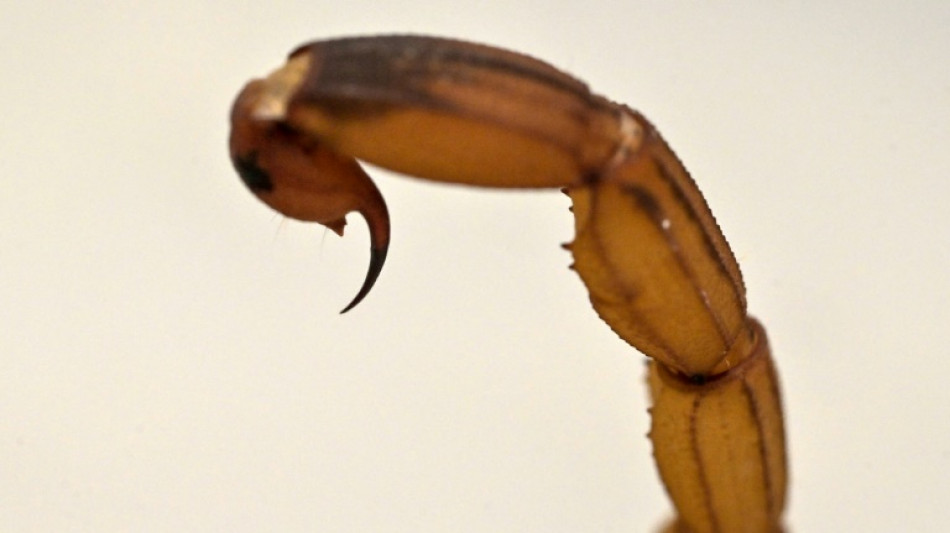
Thriving scorpion population is stinging problem for Brazil / Photo: Nelson ALMEIDA - AFP

Thriving scorpion population is stinging problem for Brazil

Forget snakes, it's scorpions Brazilians most need to worry about.

Text size:

The arachnids -- feared for the toxic stinger poised atop their tails -- are proliferating thanks to urbanization and warming temperatures.

The result is that scorpions have become the most lethal poisonous animal in Brazil, posing a growing danger for people across the whole country -- and spurring demand for antivenom.

The most widely found species in the country, the Brazilian yellow scorpion, is the most dangerous scorpion in South America.

Unusually for scorpions, this all-female species also reproduces asexually, reducing population-control options.

"With a warming habitat, these animals' metabolisms are also warming, so they are more active, eating more and reproducing more," explained Thiago Chiariello, production coordinator of the scorpion antivenom lab at Brazil's Instituto Butantan in Sao Paulo.

Add to that rampant urbanization which both scares away scorpions' natural predators such as lizards and birds while boosting the number of available cockroaches -- tasty meals for the arachnids -- and the problem is evident.

"Cities are growing unchecked" and the spread of trash they bring means more food supply for scorpions, Chiariello said.

"This is leading to more contact with people, which means more accidents."

- Soaring sting numbers -

Last year -- the latest dataset available -- there were 152 deaths from scorpion stings in Brazil, compared with 140 from snakebites. That was an increase from 2019, when 95 deaths by scorpion sting were recorded.

According to Brazil's health ministry, there were more than 200,000 scorpion sting incidents registered last year -- 250 percent more than a decade earlier, and an average of nearly 550 stings per day.

Healthy adults might get mild to moderate symptoms from a Brazilian yellow scorpion sting, including pain, vomiting, profuse sweating and tremors.

But there are more severe symptoms -- including shock, fluid build-up in the lungs, cardiovascular collapse and heart failure -- that can prove deadly, especially for children and the elderly.

- Life-saving antivenom -

That makes the Butantan institute's antivenom very important.

Chiariello's team carry out their serum-making task in making that serum with extreme precision.

They first use tweezers to guide a live scorpion's stinger into a container.

The poison is then injected into horses, which are less vulnerable to the toxin's effects than humans, and which produce more antibodies.

"There is a whole purification process in the horses' blood," explained Paulo Goldoni, a biologist at the institute.

"The serum is the only way to save lives," he said.

Last year saw more than 11,000 people in Brazil receive scorpion antivenom, mostly in the country's heavily populated southeast, according to authorities.

With serum demand growing, but also the number of available scorpions, the Instituto Butantan has a steady supply of venom donors.

"If ever there was a lack of serum, we would certainly see a serious increase in the number of deaths," the biologist said.

(U.Gruber--BBZ)