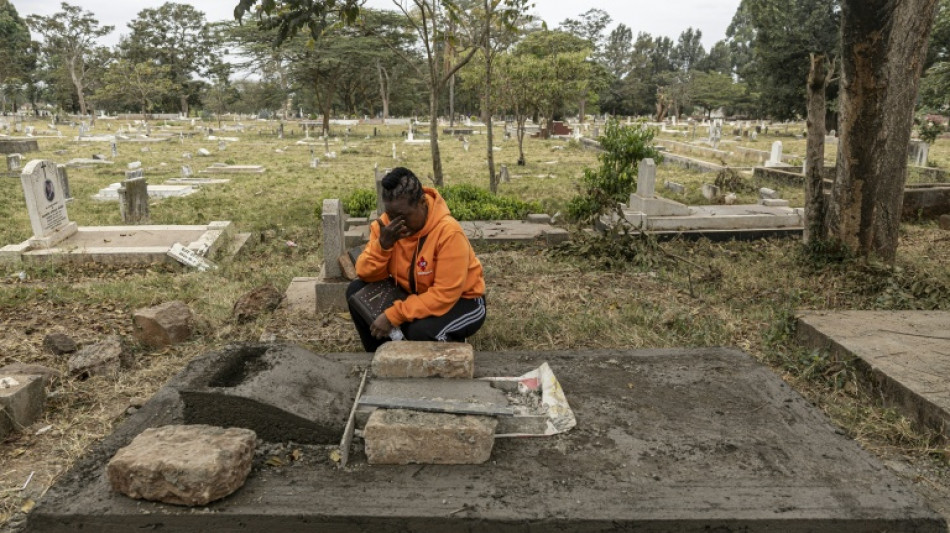
US aid cuts are killing Kenyan sex workers / Photo: SIMON MAINA - AFP

Under an unmarked block of concrete in a Nairobi cemetery lie the remains of Judy, an HIV-positive Kenyan sex worker, who died just hours before she was due to meet AFP last month, one more victim of US aid cuts.
AFP has confirmed the deaths of at least 24 HIV-positive sex workers in Kenya who, like Judy, were in good health until aid was slashed by the United States in early 2025, according to frontline health staff.
The real number of deaths is likely far higher, and NGOs say there is already a huge spike in HIV infections among sex workers that will likely spark a "catastrophic" rise in cases among the general population.
The US has long been the biggest donor to Kenya's health system, but the Trump administration has restructured support away from NGOs, and passed rules to prevent them promoting issues it opposes.
A July 2026 report by the Foundation for AIDS Research (amfAR) found that 73 percent of US-funded organisations had been forced to end services to "key populations" -- sex workers, LGBTQ communities, and drug users -- despite them facing the highest risk of infection.
Kenya had dozens of clinics catering specifically to sex workers, providing antiretroviral drugs, condoms, and other preventive treatments -- peer-led places where they would not face questions and disapproval. Most have now closed.
Kenyan authorities estimate there are 285,000 women engaged in sex work in the east African nation, with an HIV prevalence rate of 27.5 percent. Experts fear a surge in infections if they are no longer targeted for health support.
Decades of progress are being put at risk, UNAIDS chief Winnie Byanyima told AFP.
"This is the most serious disruption in the HIV response since the world came together to fight this disease," she said.
- Stigma -
Nearly 1.5 million people, or 3.2 percent of Kenya's population, live with HIV.
Judy, 36, was diagnosed in 2017, according to her friend Diana, also a sex worker. She had learned to manage with the help of the Bar Hostess Empowerment and Support Programme (BHESP), an NGO supporting sex workers that delivered medication, condoms, and sometimes food to her in the Mathare slum of Nairobi where she lived.
Like most in her profession in Kenya, Judy lived in extreme poverty, sometimes selling sex for 50 or 100 Kenyan shillings (40 or 80 cents) or in exchange for food for her four children.
She could not afford the transport to go herself to a BHESP clinic, so when the NGO lost its funding with the dismantling of USAID last year and its outreach teams were fired, Judy was left without support.
Sex workers say they are terrified to enter public hospitals, knowing the intense stigma they will face in the conservative, majority-Christian country.
There is also discrimination against HIV-positive people, and they fear neighbours will learn of their diagnosis and turn them and their children into outcasts.
- 'Kill order' -
Judy stopped taking her medication, despite the risks, and her immune system collapsed.
"She had sores... Her skin was so rough," said Diana. AFP is only giving first names of sex names to protect their identities.
Judy is one of three HIV-positive sex workers from Mathare confirmed dead in recent months after stopping their treatment, according to BHESP. Several others have died in similar circumstances in the neighbouring slums, Diana said.
"The stop-work order from the US administration, for us, is a kill order," said Daisy Kwala, programmes director for BHESP.
The NGO had two centres funded by USAID. It closed the first in September 2025, and the second will close by the end of this month.
Of the 14,500 sex workers treated by these two clinics, some 12,000 have completely dropped off BHESP's radar, including 2,300 who were HIV-positive.
Kenya had been making major progress on HIV/AIDS with its international partners, said Douglas Bosire, head of the National Syndemic Diseases Control Council, pointing to a drop in new infections from around 110,000 in 2005 to 13,936 in 2025.
But he warned "there is a risk of us reversing the gains if we do not quickly get this key population (sex workers)... to go to public facilities."
The Sex Workers Outreach Programme (SWOP), a Nairobi NGO monitoring 45,000 people in the profession, recorded a 48 percent rise in new infections in the first half of 2026 compared to the same period in 2024. Half of SWOP's clinics have closed due to USAID cuts.
BHESP recorded a 14-fold increase in infection rates at its surviving centre in the Roysambu suburb between one quarter in 2024 and the same period in 2026.
Less regular monitoring means patients present with more advanced conditions and a higher viral load.
"They come for treatment late, and before they come, they will have transmitted more HIV to their customers in the community," said BHESP nurse Sharon Lagat.
"These customers... are our parents, our husbands, our friends, so definitely at the end of the day, the virus will reach to our homes."
- Dr Death -
Doctor Joshua Kimani, SWOP's renowned clinical and research director, said he fears "going back to where we were in 1990s" when infections were "out of control".
A veteran of the fight against the virus, he recalls 1998 as his "worst year".
"I became 'Dr Death' because of telling people to go home, to die at home," Kimani told AFP, "I don't want to go back there."
He said rising infections among sex workers will lead to rising numbers in the general population.
"We cannot treat ourselves out of this epidemic. We need prevention," he said.
Bosire said the government could only budget for 200 million of the 500 million condoms it needs to distribute freely each year.
Sex workers can rarely afford a three-pack of condoms, priced at 100 shillings (80 cents).
"(But) they will still sell sex, they will still meet 6 to 10 people in a day, and that puts the entire community at risk," said Kwala.
In the coastal region, there have been 14 deaths of HIV-positive sex workers who lost access to treatment, according to the Coast Sex Workers Alliance, an NGO.
At least five have died in Kenya's west, according to the Kisumu Sex Workers Alliance, and two more near the Ugandan border, according to Survivors of Busia.
None of the 25 USAID-funded clinics for sex workers across western Kenya have survived, said Dorothy Agalla, director of the Kisumu NGO, with fewer than 1,000 of their 20,000 sex workers now receiving care at public facilities.
- 'Gone' -
Overcome with grief, Cecilia mourns her friend Beatrice.
Both were sex workers. Beatrice, 43, stopped taking her antiretrovirals when visits from BHESP members in Mathare ceased, fearful of the stigma she and her children would face at a public clinic.
"She started deteriorating... then, poof, she was gone," her friend said.
Beatrice died in her bed on August 24, 2025. Her sister Rosemary, 29, also a sex worker with HIV, died a year later.
Cecilia implores President Donald Trump to reverse the cuts and "bring us what we had".
"Please, we'd be very happy," she whispered.
The Trump administration's deputy assistant secretary for Africa, Frank Garcia, visited Nairobi on September 9, in part to promote a new health partnership based on "trade not aid".
He rejected any US responsibility for the deaths among sex workers.
"I completely push back on the narrative that... the most generous nation in the world with regard to AIDS research, AIDS funding, and AIDS distribution of life-saving methodologies, is in any way responsible for that," he told AFP.
(Y.Yildiz--BBZ)