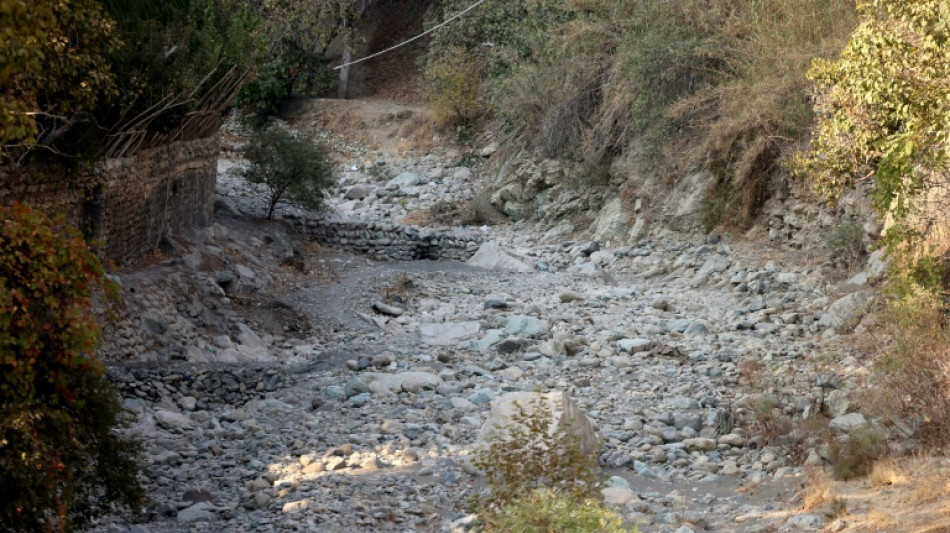
World's water cycle becoming more unpredictable, UN warns / Photo: ATTA KENARE - AFP

The planet's water cycle is becoming increasingly erratic, swinging between too little and too much, the United Nations warned Thursday, with an unprecedented El Nino expected to exacerbate the long-term trend.
Last year was among the driest for the world's rivers in over three decades, the UN's World Meteorological Organization said in a report.
In 2025 -- one of the warmest years on record -- glaciers also shrank across all regions, even as groundwater levels in many parts of the world are in multi-year decline, it found.
Overall, the WMO's annual State of Global Water Resources report showed that the Earth's freshwater storage -- the total amount of water stored in groundwater, lakes and rivers, soil moisture, vegetation and ice and snow -- continued a decade-long decline.
Some elements of the water cycle change rapidly -- like precipitation, river flow and soil moisture, responding to weather within days or weeks.
WMO Secretary-General Celeste Saulo voiced particular concern about the decline in "slow reserves", like groundwater and glaciers, which she said had traditionally served as the planet's "savings account".
They have served as "a buffer that absorbs bad years so that a single drought or a single dry season does not translate directly into a water crisis", she told reporters.
- 'Spending our reserves' -
Now, "we are depleting that savings account", she warned. "We are spending our reserves."
Glaciers have also been shrinking at a precipitous rate, with 2025 marking the fourth consecutive year where they shed significant ice mass across all regions.
Between 2023 and 2025, the report estimated that glaciers lost a cumulative global glacier mass of 1,400 gigatonnes of water -- roughly equal to the water required to fill 560 million Olympic-sized swimming pools, or about a third of the world's annual freshwater withdrawals.
"Groundwater tells a similar story: nearly two-thirds of monitored wells worldwide showed conditions outside the historical norm in 2025," Saulo said.
She highlighted that this was happening in parallel with "more water-related disasters".
In particular, she pointed to the current El Nino pattern, which is expected to be the strongest since comparable records began four decades ago.
El Nino is the warm phase of a natural climate cycle that occurs every two to seven years and is characterised by above average ocean temperatures across the Pacific, and brings worldwide changes in winds and rainfall patterns and erratic weather.
"The strengthening El Nino will increase the risk of drought in some areas, and flooding in others," Saulo cautioned.
- 'Abnormal' -
Already before El Nino hit, rivers worldwide were showing "abnormal" flows, WMO said, with 2025 among the three driest years for rivers in 35 years.
For a seventh year in a row, the number of river basins globally experiencing "normal" conditions were in a clear minority in 2025.
Only around 36 percent saw normal flows, while an equal percentage saw below-normal discharge conditions and 21 percent were above normal, the report found.
The WMO stressed the importance of good data to map the developments in the water cycle, warning that significants gaps remained in hard-hit areas.
"Weather respects no borders, and this is especially true for water," Saulo said, arguing for the importance of "shared data, shared standards and shared early warnings".
"A river basin is fed by water upstream, often in another country," she pointed out.
And "a glacier disaster in one country can lead to devastation in another as we saw with the recent tragedy of China and Nepal".
(O.Joost--BBZ)