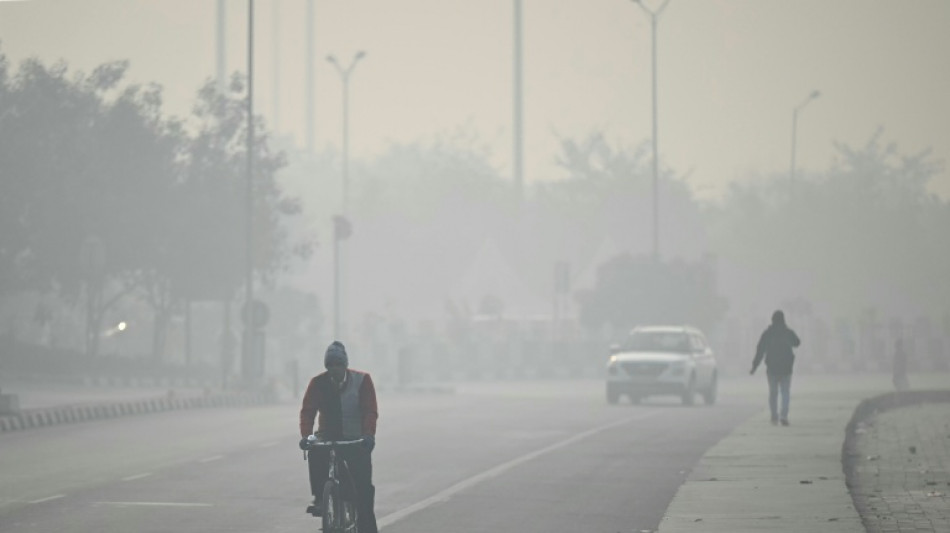
One third of world population exposed to harmful air pollution: monitor / Photo: Sajjad HUSSAIN - AFP/File

Heatwaves and wildfires combined with human-caused emissions this year combined to expose one third of the world's population to extremely high levels of ozone pollution, a European Union report said on Wednesday.
In a new analysis covering the first eight months of 2026, the European Union's Copernicus Climate Atmosphere Monitoring Service (CAMS) highlighted the close relationship between climate change and air pollution.
When heat and sunlight react with airborne emissions from wildfires, vehicles and industry, they create ground-level ozone pollution, which can damage lung tissue, cause breathing problems, trigger asthma attacks and lead to other health issues.
Despite progress in cutting the most harmful air pollutants in recent decades, ozone has proved more difficult to tackle as climate change fuels the conditions that favour its formation.
This year's ozone pollution was driven in part by record-breaking heatwaves and wildfires that seared Europe and North America and sent smoke well beyond their borders.
Indonesia has experienced major wildfires, while the warming El Nino weather pattern, which started in June and is due to peak later this year, could drive more fires in southeast Asia, according to the analysis.
"Air pollution does not stop at borders. It can travel thousands of kilometres, crossing continents and oceans and affecting air quality far from its source," CAMS director Laurence Rouil said in the Atmosphere Watch report.
- 'Extremely poor' air -
CAMS uses satellite data and computer models to track air pollution and wildfires.
The report found that 34 percent of the global population was exposed to "extremely poor" air quality between January 1 and September 15, meaning concentrations of ozone were well above the World Health Organization's exposure guidance.
The WHO's guideline sets 100 micrograms of ozone per cubic metre as the maximum recommended level of exposure, averaged over eight hours.
Another 17 percent of the world breathed "very poor" air, while five percent was exposed to "good" levels of ozone.
Asia has the highest rate of exposure to ozone pollution, with 53 percent of its population breathing "extremely poor" air. Another 22 percent was exposed to "very poor" ozone.
The continent's widespread emissions are driven by industrialisation, economic development and transport, as well as wildfires and the burning of agricultural residue.
New Delhi, Dhaka, Chinese megalopolis Chongqing and Pakistan's Lahore were among cities whose ozone levels were "extremely poor".
Two thirds of the population in North America and 45 percent in Europe were exposed to "poor" or "very poor" air quality.
EU regulation has been effective in reducing emissions from air pollutants, except for ozone, the report said.
Ozone pollution is linked to 60,000 premature deaths per year in Europe, Ian Marnane, an official at the European Environment Agency, told a media briefing.
Ozone levels in North America also remained "relatively unchanged" despite ambitious emissions reduction policies, the report said.
Smoke from forest fires, crop burning and cooking are significant contributors to Africa's air pollution while Saharan dust travels as far as Europe.
Eight percent of Africa's population endured "extremely poor" air quality this year. It was "very poor" or "poor" for 19 percent of the continent.
Ozone levels were very high in the Brazilian city of Sao Paulo and extremely elevated in Rio de Janeiro but the air quality was "good" or "fair" for 81 percent of South America's population.
One bright spot was Oceania, including Australia and New Zealand, where 66 percent of the population enjoyed "good" ozone levels and 34 percent lived under "fair" conditions.
(H.Schneide--BBZ)